What is headless, and is it right for your website?
At some point a developer or agency will say the word “headless”. It sounds odd, and it’s often explained in a way that leaves non technical people nodding politely.
Here’s the plain version, along with an honest look at when it’s worth it and when it isn’t.
What headless actually means
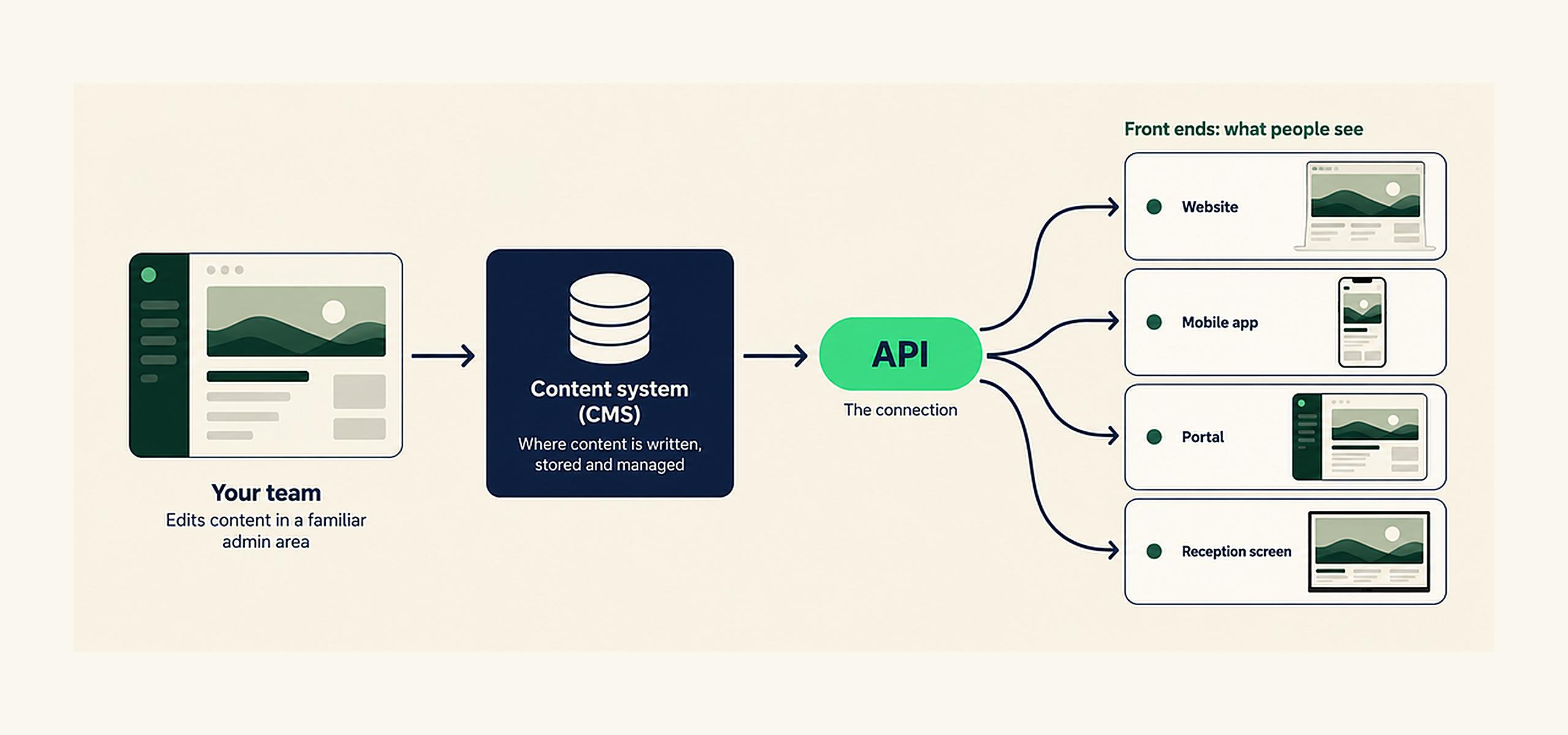
A traditional website keeps everything in one system. The place where your team edits content and the pages your visitors see are tied together.
A headless website separates them. Your content lives in one central place, and a separate front end, the “head”, displays it. The two talk to each other through a connection called an API.
Think of a restaurant kitchen. The kitchen makes the food once, then it can be served in the dining room, packed for takeaway or sent out through a delivery app. The kitchen doesn’t care where the meal ends up. Headless works the same way for your content.
What changes for your team
Less than you might think. Your editors still log in to a familiar admin area to update content. Visitors still see a normal website. The difference is in how it’s built underneath, and what that makes possible.

Where headless helps
- Speed: The front end can be built to load very quickly, which visitors and search engines both notice.
- One source, many places: Write content once and use it on your website, a mobile app, a portal or a screen in your reception.
- Design freedom: You can redesign the front end without rebuilding all your content.
- Easier connections: Linking to other systems, like a CRM, a booking tool or AI features, is usually simpler.
- A stronger security position: Your content system isn’t directly exposed to the public, which can reduce the risk.
What it costs you
This is the part that often gets left out.
- More moving parts: You’re looking after a content system and a front end, not one platform.
- Higher upfront cost: There’s more to design, build and test.
- Some features need building: Things like page previews, forms and SEO tools sometimes have to be set up deliberately, where a traditional platform gives them to you.
- It needs an experienced team: Headless done badly is slower and more expensive than a standard website.
When it's a good fit
- Your content needs to appear in more than one place
- You have complex integrations with other systems
- You expect high traffic or fast growth
- You're building a platform for the long term, not a short term site
- You want real freedom over design and performance
When a traditional website is probably enough
- You need a simple brochure style site
- Your budget or timeline is tight
- You don't have technical support to look after it afterwards
- Your needs are standard, and a well built platform already covers them
Many organisations fall into this second group, and that’s perfectly fine. Choosing a simpler approach isn’t settling for less. It’s matching the solution to the problem.
Three questions to ask
- 1.How many places will this content need to appear, now and in three years?
- 2.Who will look after both parts once it's live?
- 3.What will it cost us if we need to change direction later?
If the answers point to one website and a small team, a traditional build is usually the sensible choice. If they point to several channels, integrations and growth, headless is worth a serious look.
Where to start
You don’t have to decide on the technology first. Start with what you need the website to do, and let the architecture follow. If you’d like a straight answer on whether headless suits your organisation, we’re happy to talk it through.
Related
Do you need a developer, or a digital team?
One developer or a wider digital team? Learn what each does well and how to decide.
Learn more
How to read a technology proposal with confidence
Nine questions to ask when reviewing a technology proposal. No technical background needed.
Learn more
How to stop coordinating five suppliers on your own
Too many technology suppliers create hidden work. Learn what good coordination looks like.
Learn more